BUDGETS AND FUNDING
Annual budgets, capital reserves, grants, bonds, referendums, federal or state programs and approved funding activity.
K–12 SALES INTELLIGENCE FOR EDUCATION VENDORS
Quantum Leaps monitors the public evidence behind K–12 purchasing, investigates meaningful district developments and turns the strongest signals into prioritized account intelligence and practical sales direction.
Your representatives receive the evidence, buying-stage context, unanswered questions and recommended first move—not another flat district list.
PUBLIC EVIDENCE · COMPLEX BUYING PROCESS
A meaningful district opportunity may develop across several budget years, departments, public meetings, funding sources and procurement stages. Understanding the situation requires more than finding one bid notice.
Annual budgets, capital reserves, grants, bonds, referendums, federal or state programs and approved funding activity.
Board agendas, meeting minutes, leadership changes, presentations, strategic plans and publicly discussed district priorities.
Capital projects, construction packages, technology plans, RFPs, RFQs, bids, awards, cooperative contracts and implementation activity.
Existing standards, deployment phases, replacement cadence, maintenance needs, service requirements and adjacent opportunities.
The research must determine what stage the district is actually in, what the evidence supports and whether meaningful scope may still remain.
THE PUBLIC BID MAY BE A LATE-STAGE SIGNAL
A district identifies an instructional, operational, facility or technology need.
Technology, curriculum, facilities, business and leadership considerations begin to take shape.
Budget language, grants, reserves, bonds, capital plans or other funding evidence appears.
Requirements, design decisions, board approval or purchasing pathways become clearer.
A bid, RFP, cooperative purchase, direct purchase or other procurement step becomes visible.
Deployment, training, support, maintenance, expansion, later phases and future lifecycle needs may follow.
Earlier public evidence may provide more preparation time, but it does not establish buyer intent, guarantee influence over the procurement process or prove that a vendor opportunity remains open.
FROM TERRITORY VIEW TO FIRST MOVE
Research the territory, identify credible triggers, distinguish buying stages and rank where limited selling time may be best used.
Monitor selected districts, markets and signal types for meaningful public developments requiring investigation.
Investigate the district, current initiatives, likely stakeholders, installed environment, timing, risks and important unknowns.
Prepare relevant positioning, account-specific questions, call direction, outreach guidance and recommended follow-up based on the evidence.
Opportunity Intelligence identifies where to focus. Radar monitors what changed. Account Intelligence develops the district context. Sales Activation helps prepare the conversation.
DECISION-READY K–12 DELIVERABLES
A concise alert covering the public development, evidence, likely relevance, buying-stage concerns and recommended next question.
A prioritized view of meaningful district activity across the agreed market or account group.
A deeper account view covering current initiatives, stakeholders, funding context, timing, risks, unknowns and pursuit considerations.
Practical call preparation, relevant outreach direction, qualification questions, talking points and recommended follow-up.
BETTER FIELD PREPARATION · CLEARER LEADERSHIP VISIBILITY
The representative keeps the relationship, live discovery, judgment and close. Quantum Leaps adds research, monitoring and preparation capacity.
SEE THE RESEARCH STANDARD
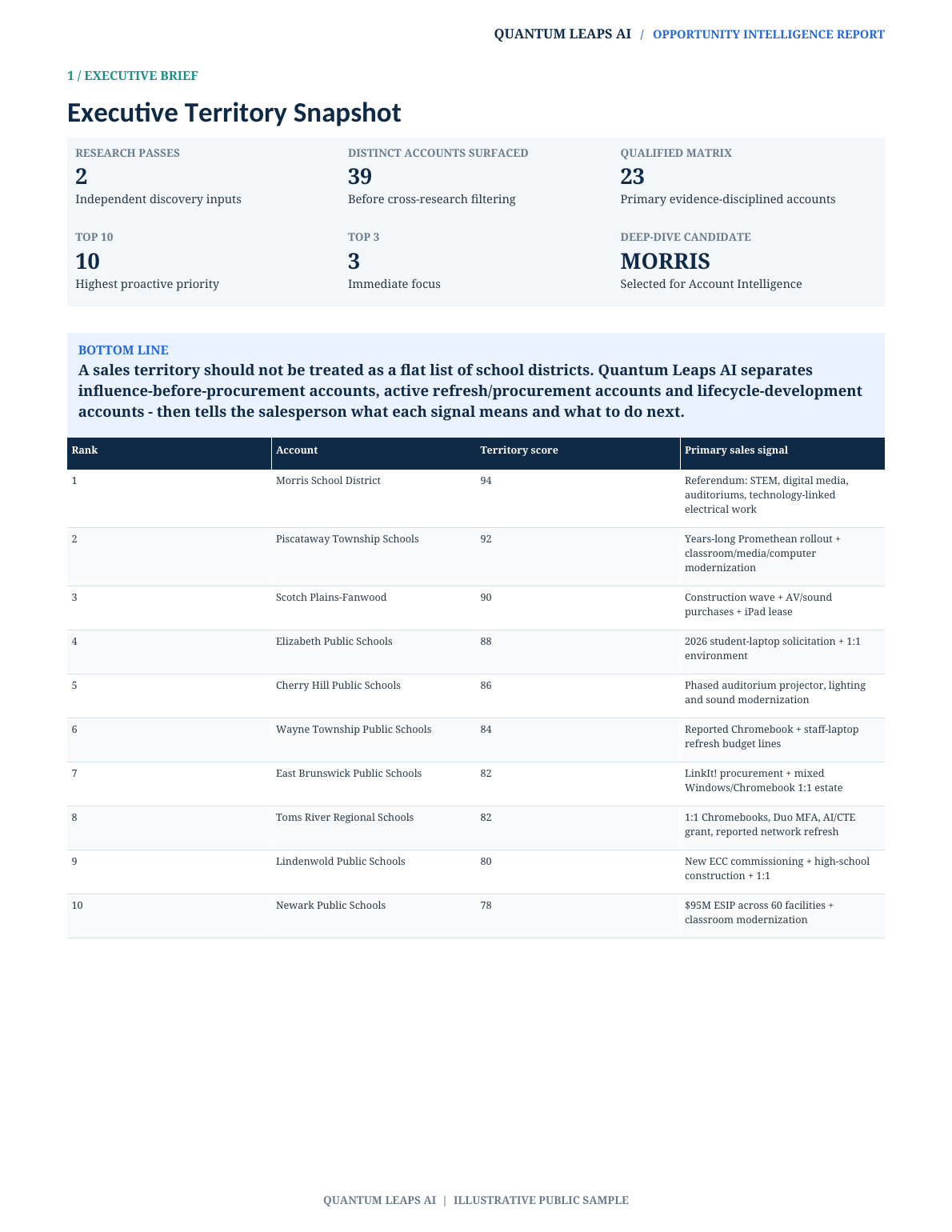
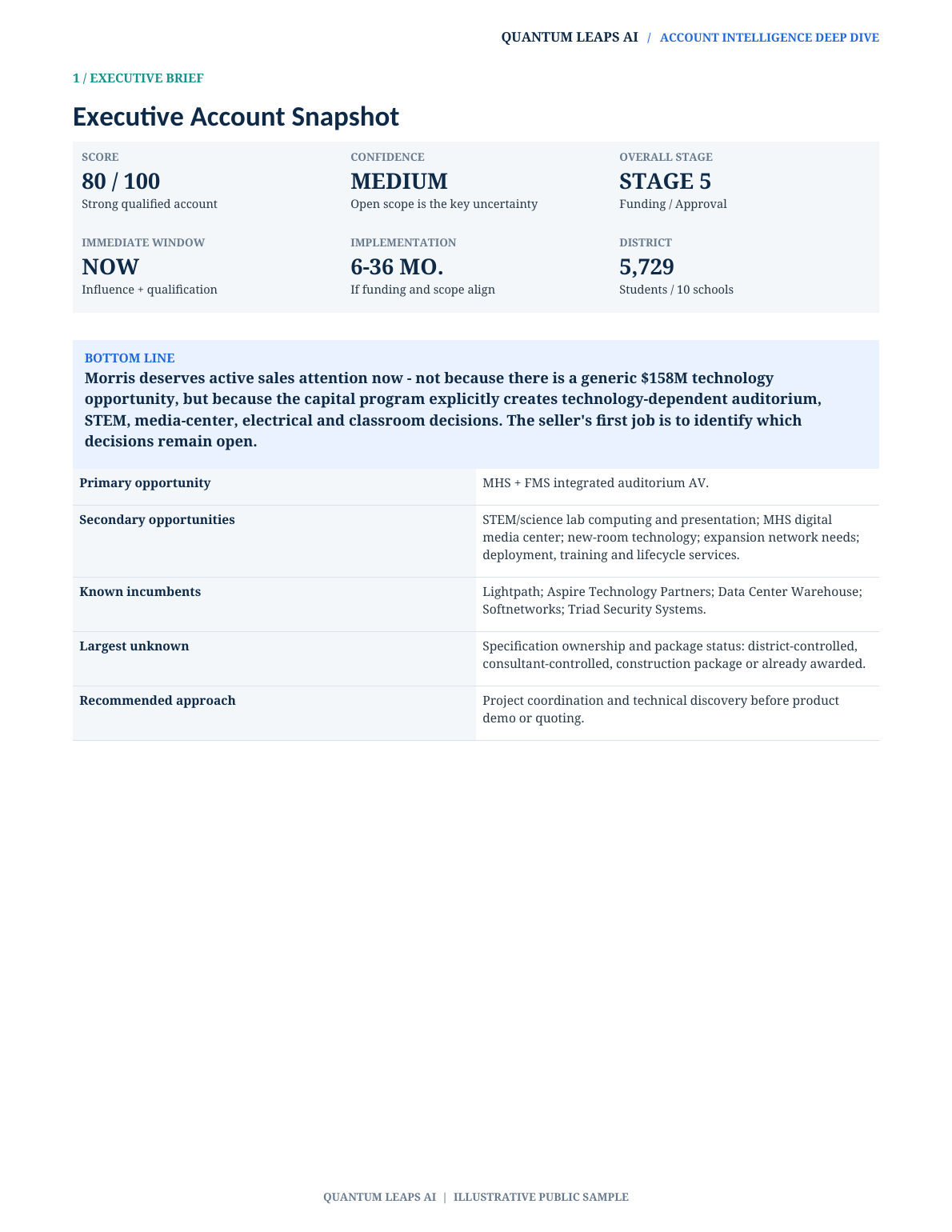
The existing New Jersey Public Education Technology report demonstrates how public district information can be organized into buying-stage discipline, prioritized accounts, evidence, risks and a recommended first move.
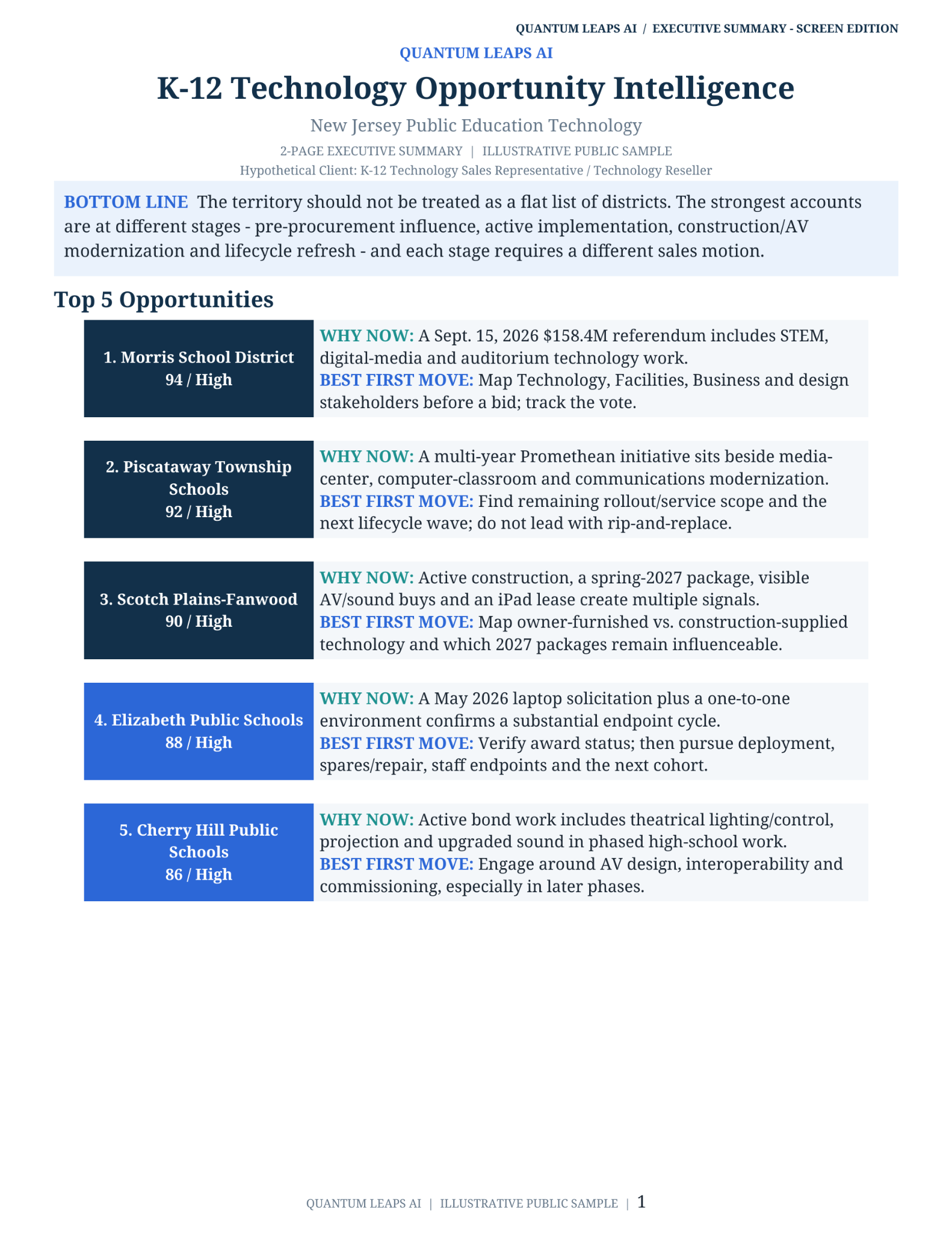
Why nowA Sept. 15, 2026 $158.4M referendum includes STEM, digital-media and auditorium technology work.
Buying stage or riskPre-procurement influence · referendum dependent
Best first moveMap Technology, Facilities, Business and design stakeholders before a bid; track the vote.
Why nowA multi-year Promethean initiative sits beside media-center, computer-classroom and communications modernization.
Buying stage or riskInstalled standard · lifecycle and adjacent scope
Best first moveFind remaining rollout/service scope and the next lifecycle wave; do not lead with rip-and-replace.
Why nowA May 2026 laptop solicitation plus a one-to-one environment confirms a substantial endpoint cycle.
Buying stage or riskProcurement visible · award status must be verified
Best first moveVerify award status; then pursue deployment, spares/repair, staff endpoints and the next cohort.
District opportunities should be separated by buying stage, timing, evidence and remaining influenceability.
A closed bid, an installed product standard or an approved facilities project does not automatically represent an open first-time sales opportunity.
The service connects public evidence to account fit, timing, risk, stakeholders, unanswered questions and the next justified sales motion.
This is a time-bound illustrative public sample prepared for a hypothetical client using publicly available information. Organizations mentioned have not necessarily expressed interest, and no affiliation, endorsement, buyer intent or guaranteed outcome is implied. Every finding should be reverified before real sales action.

THOROUGH RESEARCH · HUMAN REVIEW
AI expands the amount of public information that can be searched, reviewed and compared. Human judgment is still required to evaluate the source, determine the buying stage, distinguish fact from inference and decide whether the development deserves sales attention.
Directly supported by an appropriate identifiable source.
Credible evidence suggests movement, but important details still require confirmation.
A clearly identified commercial interpretation based on available evidence.
Information that remains unsupported, unavailable or unresolved.
The relevant stakeholders vary by project, district structure and buying stage. Titles and decision authority must be verified rather than assumed.
ONE ASSIGNMENT, ONGOING MONITORING OR TEAM COVERAGE
A defined research engagement around a selected K–12 territory, account group, product category or commercial question.
Ongoing Opportunity Radar monitoring, investigation, prioritization and follow-through across an agreed K–12 scope.
Customized support across multiple representatives, territories, product lines, account groups or management-reporting needs.
An engagement may begin with one representative, one territory, one product category or one selected account group and expand when broader coverage becomes useful.
COMMON QUESTIONS
No. A district list only shows which organizations exist. K–12 Sales Intelligence investigates public evidence, identifies meaningful developments, distinguishes buying stages and explains why an account may or may not deserve attention.
No. Depending on the client’s market, research may include budgets, board activity, grants, capital plans, construction, technology planning, contract activity, leadership changes and replacement-cycle evidence. Formal procurement is only one possible stage.
No. Public information may indicate planning, funding or activity, but it does not prove buyer intent. Findings distinguish verified facts, supported indications, strategic inferences and unknowns.
The normal service provides research, prioritization and Sales Activation preparation. The client’s representative retains the relationship and conducts the actual sales conversation unless a different service is specifically agreed.
No CRM or internal email access is required to begin. The work can be built primarily around public and commercially available information together with appropriate context the client chooses to provide.
Yes. An engagement can begin with one representative, territory, product category, district group or business-development objective.
The public sample demonstrates the research method and presentation standard. Its findings are time-bound and should be reverified before any real sales action.
No. The service can improve awareness, preparation, prioritization and commercial decision-making, but it cannot guarantee buyer intent, procurement outcomes, contracts or closed sales.
BETTER DISTRICT INTELLIGENCE BEFORE THE NEXT CONVERSATION
Share your product or service, target districts, territory and the developments that would create a meaningful sales opportunity. We will discuss the most practical research, monitoring and account-preparation scope.
SALES PROFESSIONALS & TEAMS · CUSTOMER & TEAM SUPPORT
Choose a customer assistant, a staff assistant, or both. Each is built around the information, people, and procedures you approve.
CUSTOMER ASSISTANT
Help prospects explore approved product information, compare options, and prepare a useful demonstration or sales inquiry.
Discuss customer support →STAFF & OPERATIONS ASSISTANT
Help representatives learn the product line, find approved sales guidance, prepare for meetings, and bring unresolved questions to the sales manager.
Discuss staff support →Explain approved product positioning, demonstration procedures, and internal handoff steps.
Find approved reference material, qualification checklists, and questions requiring technical confirmation.
Organize recurring objections, missing product information, follow-up needs, and team training questions.
Employer-approved product documents, sales playbooks, demonstration checklists, and technical escalation contacts.
A protected employee link can open from a phone, shared tablet, or workplace QR code. Customer and internal knowledge are kept separate. Report collection, manager briefings, and notifications are configured and tested when included in your scope.