Answers and training
Staff can ask how an approved procedure works or find information needed for their role. A helpful answer does not, by itself, record an issue or notify a manager.
A DISCIPLINED, DONE-FOR-YOU PROCESS
Tell us where customers need guidance, where staff need answers, and what should reach a manager. We organize your approved knowledge, configure the selected workflows and keep the assistant useful as your business changes.
Start with customers, your team, or both. Focused market research is available as a separate service.
YOUR MANAGED ASSISTANT
You provide the business knowledge and priorities. We turn them into the customer and staff experiences you choose.
Decide whether to support customers, staff, or both. Define the questions it should answer, the tasks it should help with and what needs human attention. Setup and ongoing scope are agreed before work begins.
Provide relevant documents, text, website information and examples directly. Customer material may cover products, services and inquiries. Staff material may cover onboarding, procedures, policies and shift checklists.
We separate public and internal knowledge, set up protected staff access and agree who handles unanswered questions. If reporting is selected, we define fields, storage, recipients, notifications and the briefing schedule.
Review realistic questions and test access, inquiry handoffs and selected reporting workflows. After launch, we handle agreed updates, sample conversations and flag recurring questions or training gaps for review.
Employees can open a protected link from a phone, shared device or workplace QR code. The link is an entry point; employee access controls protect the internal experience.
SEPARATE SERVICE: SALES INTELLIGENCE
A few practical answers allow Quantum Leaps to determine which sources, signals, accounts and research formats are most relevant to the decision.
The product, service, solution or commercial capability you want to grow.
The customer types, organizations, decision environments or account categories that matter.
The geography, territory, market, named accounts or customer segment to examine.
The timing, size, fit, urgency, project type or other criteria that determine whether something deserves attention.
ONE CONSISTENT METHOD
Every research engagement follows the same disciplined reasoning process, even when the market, source environment and final deliverable are different.
Investigate credible sources, organizations, accounts, projects and market signals connected to the client’s sales objective.
Check decision-relevant findings, confirm dates and sources and distinguish established facts from indications, interpretations and unknowns.
Determine what the evidence may mean to the client’s product, service, account strategy, territory and competitive position.
Evaluate timing, fit, evidence and commercial significance to determine what deserves attention first.
Translate the findings into positioning, questions, pursuit direction and a practical recommended approach.
Turn the strategy into a usable first move, such as outreach direction, conversation preparation, qualification questions or recommended follow-up.
PUBLIC SOURCES · TRANSPARENT REASONING
Quantum Leaps does not imply access to confidential records or information that does not exist. Important findings are tied to appropriate sources, dates, context and an honest assessment of what is known and what still requires confirmation.

Directly supported by an appropriate identifiable source.
Credible evidence suggests movement or relevance, but important details may still need confirmation.
A reasoned commercial interpretation drawn from available evidence and clearly identified as an interpretation.
Information that remains unsupported, unavailable or unresolved.
Unknowns are not filled with assumptions. They become research questions, discovery questions or reasons to lower confidence.
THE DIFFERENCE IS INTERPRETATION
A public announcement, budget line or organizational change may be interesting, but it becomes commercially useful only when it is connected to the client’s market and translated into a defensible next step.
FINISHED WORK YOU CAN USE
Not every engagement requires the same report. Quantum Leaps selects the format and depth that best support the agreed commercial objective.
A focused, evidence-backed view of one prospect, development, project, signal or possible opportunity.
Deeper preparation for an important account, meeting or pursuit, including current developments, stakeholders, risks, questions and recommended direction.
Broader research across a territory, industry, market or group of commercial opportunities.
A prioritized view of meaningful developments across the agreed monitoring scope, including Action Alerts, Emerging Opportunities, Watch items and reviewed background activity.
Practical outreach direction, call preparation, positioning, discovery questions and follow-up recommendations built from the intelligence.
The agreed engagement determines which formats are appropriate. Not every client receives every format in every period.
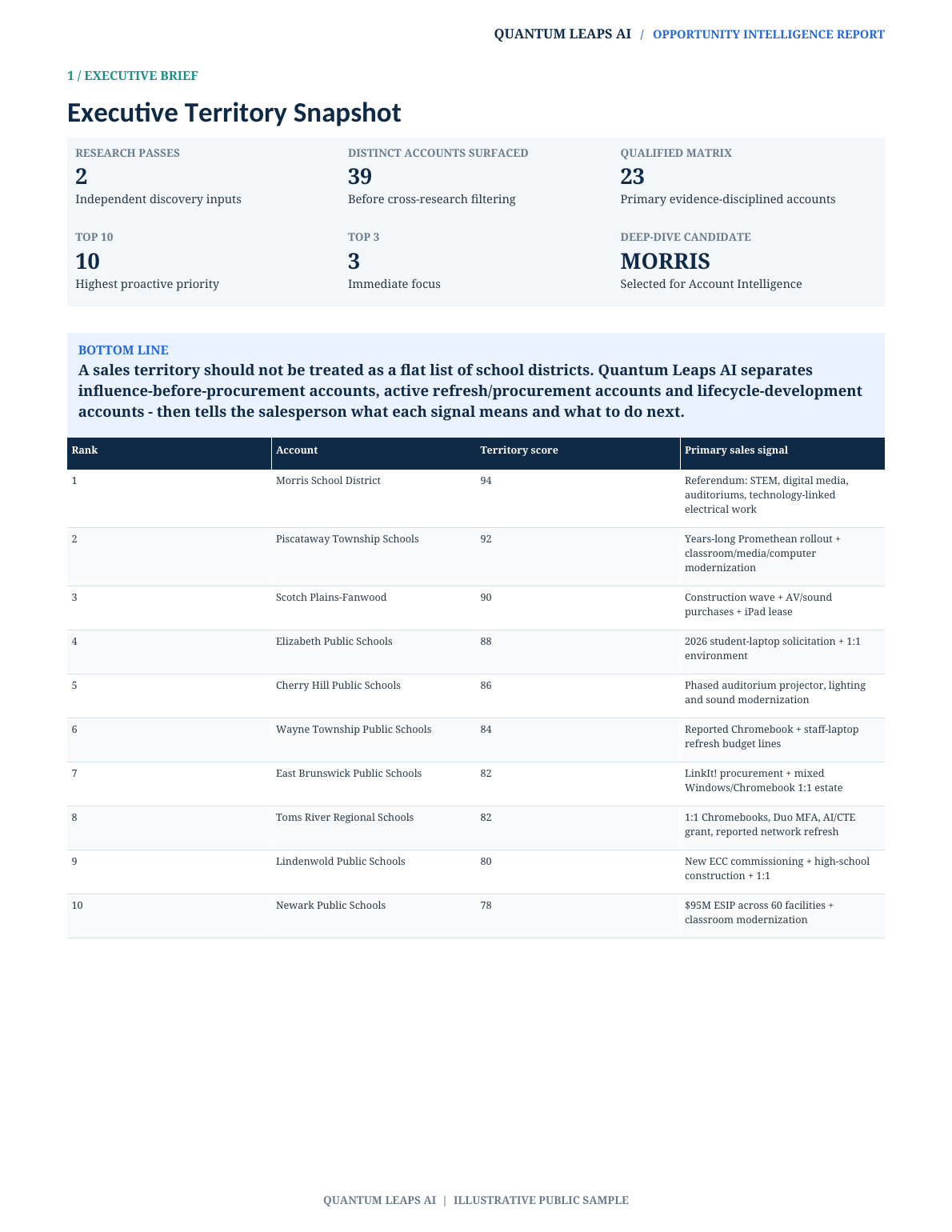
Prioritized territory findings and immediate opportunities.
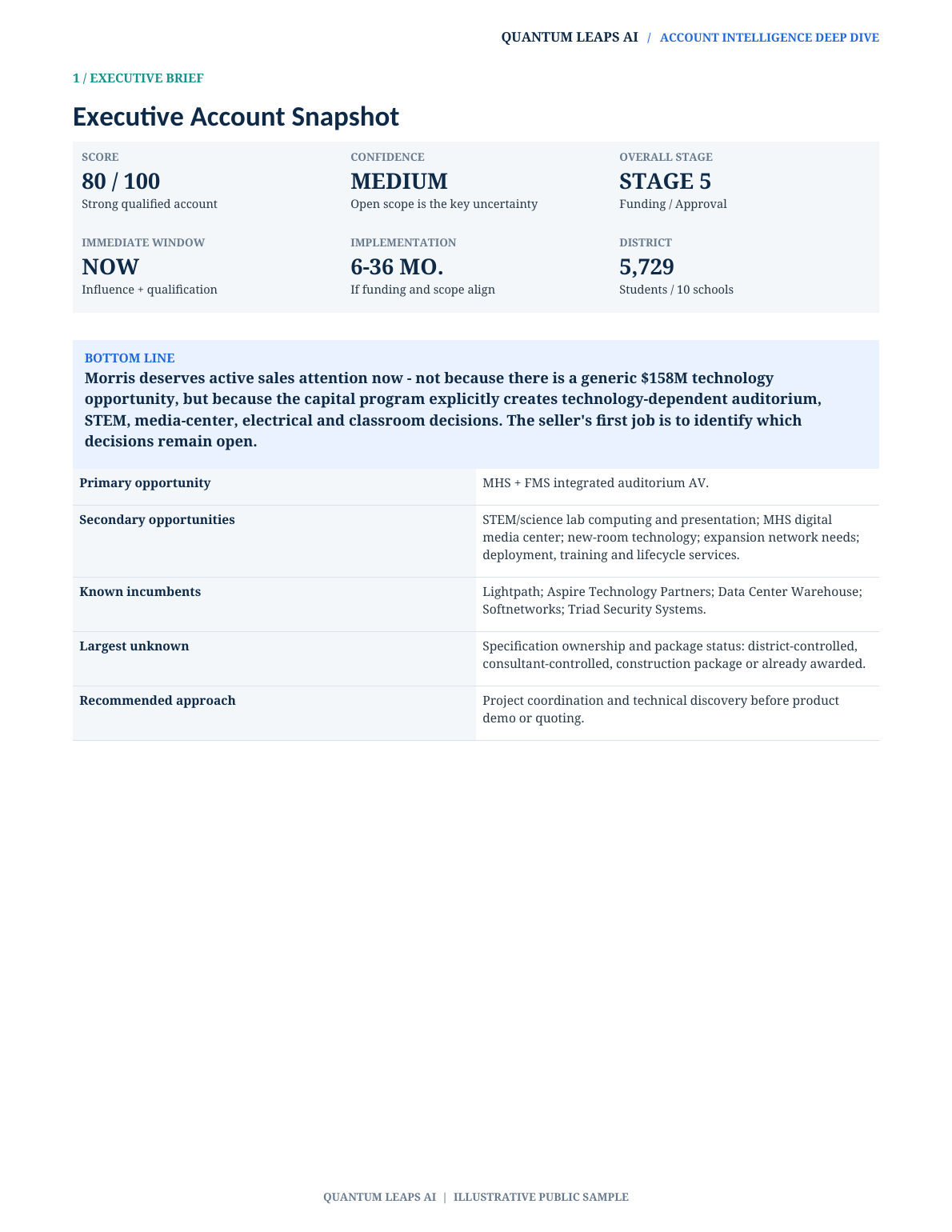
Current account context, buying stage and recommended direction.
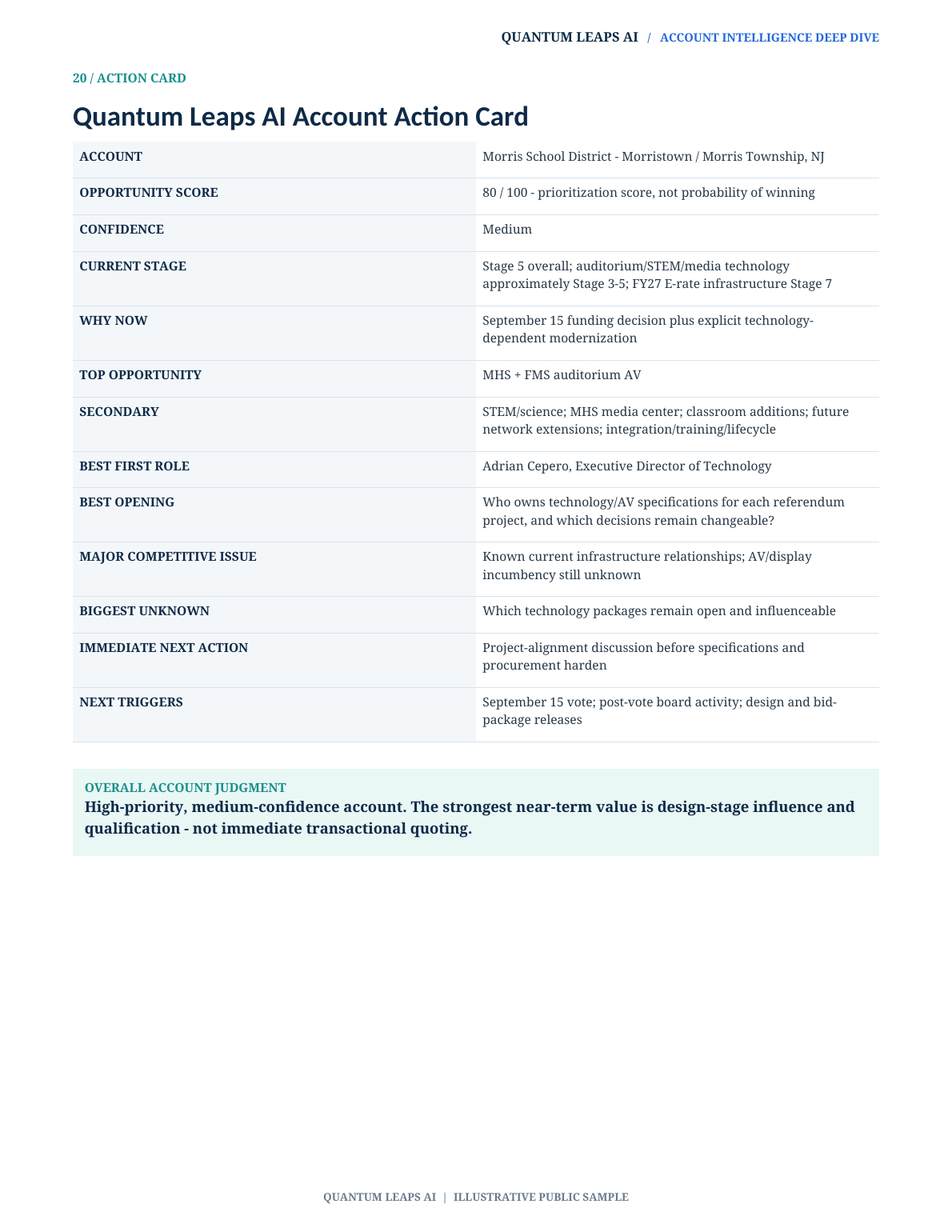
A field-ready summary of the evidence and practical next move.
WHAT THE CLIENT PROVIDES
WHAT QUANTUM LEAPS HANDLES
If proprietary information is not needed, Quantum Leaps does not request it.
SALES INTELLIGENCE OPTIONS
A defined paid research engagement for a specific market, account group or commercial decision.
View Current PricingOngoing Opportunity Radar monitoring, investigation, prioritization and follow-through within an agreed market or account scope.
Explore Opportunity RadarCustomized intelligence coverage across multiple representatives, territories, markets or account groups.
Explore Team IntelligencePRACTICAL QUESTIONS
Yes. Choose Customer Assistant, Staff & Operations Assistant, or Customer + Team. Staff work is quoted by scope; a combined proposal accounts for shared preparation. Sales Intelligence remains independently available.
Yes, when a reporting workflow is included and configured. We agree how staff submit an issue, where it is stored, who receives it and when. The public demos illustrate this process with prepared examples.
Quantum Leaps handles the agreed setup, testing, knowledge updates and ongoing review. Your business approves the information, the people who can access it and who handles unresolved questions or reports.
No connection is required to begin. You can provide documents, approved text, public web pages and examples directly. We configure additional connections only if the agreed workflow needs them. Internal assistants need your approved staff material; public research cannot supply your company procedures.
Important findings are tied to appropriate sources. Facts, supported indications, strategic inferences and unknowns are treated differently so the client can see what the evidence does and does not support.
Timing depends on the scope, research complexity and source environment. An Intelligence Sprint is normally targeted within five business days after the scope and intake information are complete. Timing is confirmed before work begins.
Yes. Ongoing priorities can shift as accounts, meetings, projects and market developments change, provided the work remains within the agreed engagement scope.
No. The service can improve awareness, preparation, prioritization and commercial decision-making, but it cannot guarantee buyer intent, procurement outcomes, contracts or closed sales.
BEGIN WITH THE DECISION IN FRONT OF YOU
Start with your customer questions, staff training, operational handoffs or market research need. We will recommend the assistant or research scope that fits and confirm the work before it begins.