The findings below are presented as responsive HTML for comfortable reading on a phone, tablet, or desktop. The original designed pages and downloadable documents follow.
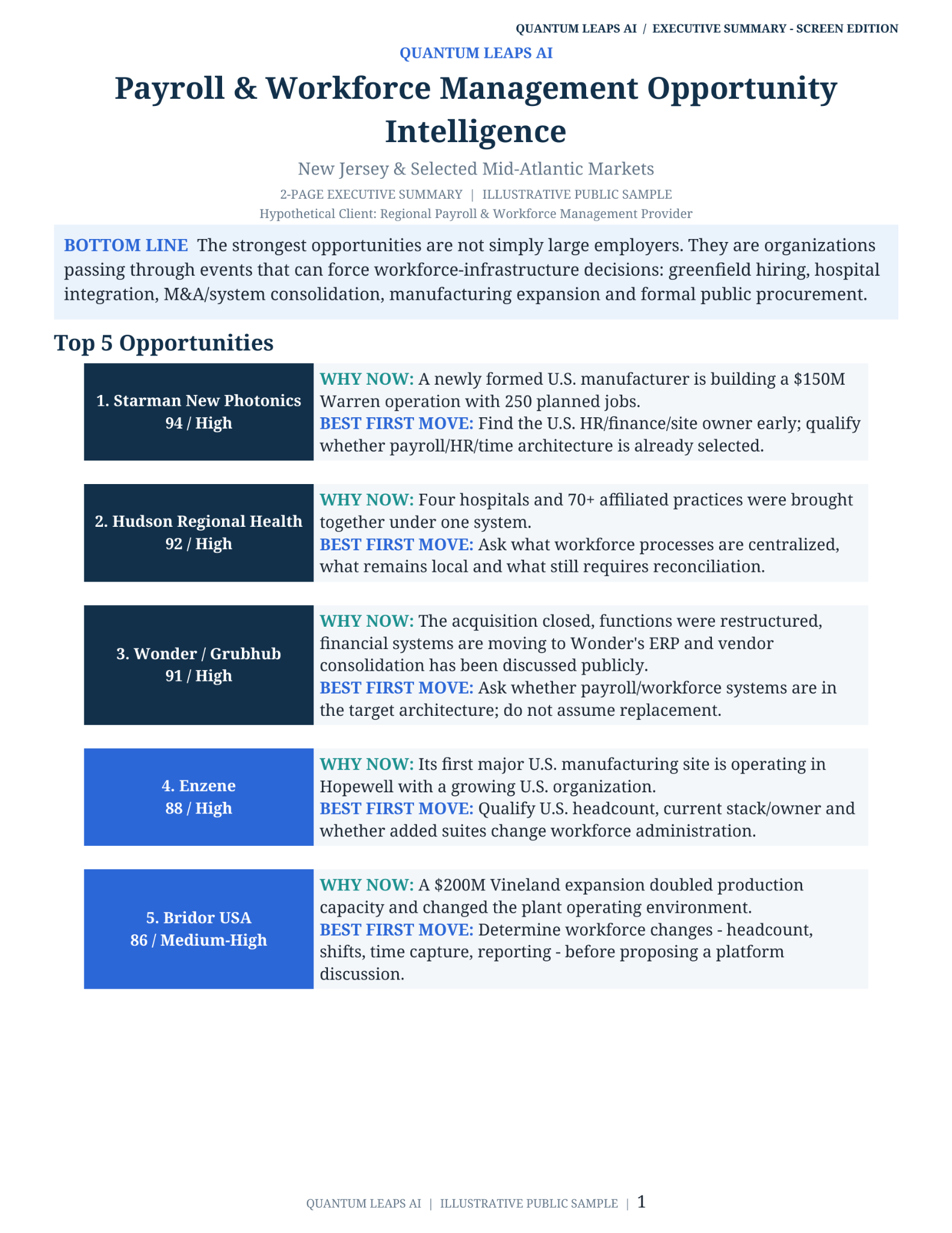
The strongest opportunities are not simply large employers. They are organizations passing through events that can force workforce-infrastructure decisions: greenfield hiring, hospital integration, M&A/system consolidation, manufacturing expansion and formal public procurement.
Top 5 Opportunities
01
Starman New Photonics
94 / High
Why now: A newly formed U.S. manufacturer is building a $150M Warren operation with 250 planned jobs.
Best first move: Find the U.S. HR/finance/site owner early; qualify whether payroll/HR/time architecture is already selected.
02
Hudson Regional Health
92 / High
Why now: Four hospitals and 70+ affiliated practices were brought together under one system.
Best first move: Ask what workforce processes are centralized, what remains local and what still requires reconciliation.
03
Wonder / Grubhub
91 / High
Why now: The acquisition closed, functions were restructured, financial systems are moving to Wonder's ERP and vendor consolidation has been discussed publicly.
Best first move: Ask whether payroll/workforce systems are in the target architecture; do not assume replacement.
04
Enzene
88 / High
Why now: Its first major U.S. manufacturing site is operating in Hopewell with a growing U.S. organization.
Best first move: Qualify U.S. headcount, current stack/owner and whether added suites change workforce administration.
05
Bridor USA
86 / Medium-High
Why now: A $200M Vineland expansion doubled production capacity and changed the plant operating environment.
Best first move: Determine workforce changes - headcount, shifts, time capture, reporting - before proposing a platform discussion.
Why these five deserve scarce selling time
Starman is early enough that workforce infrastructure may still be designed rather than deeply entrenched.
Hudson Regional Health has a real integration problem to govern even if no platform replacement occurs.
Wonder/Grubhub offers unusually direct public evidence of ERP migration, vendor review and payroll relevance.
Enzene is still forming its U.S. operating model and fits a regional-provider scale more naturally than many enterprise health systems.
Bridor gives the seller a concrete operational reason to ask what changed, rather than prospecting solely on plant size.
What the market is telling you
The Hopewell-Princeton-Plainsboro corridor deserves a specialized life-sciences account-development program.
Healthcare signals are strongest when tied to consolidation or physical network expansion, not generic hospital size.
Public-sector value comes from reconstructing contract cycles and future rebid windows, not chasing closed RFPs.
Where not to waste time
Do not treat a concluded RFP or known award as an open deal.
Do not invent an incumbent provider, dissatisfaction, current headcount or a platform-replacement decision.
Do not assume expansion or M&A automatically creates a payroll/HRIS replacement.
First 30 days
Map HR/finance/IT/operations owners across Starman, Hudson Regional Health, Wonder/Grubhub, Enzene, Bridor, BeOne, Cooper and ChristianaCare.
Send trigger-specific outreach and use first discovery to verify incumbent, system ownership and actual unresolved workforce impact.
Convert each account to a qualified or disqualified hypothesis instead of forcing all 26 accounts into active pipeline.
What Opportunity Intelligence adds
A lead list says “this employer fits your ICP.” Opportunity Intelligence says what changed, what workforce problem it may create, what is fact versus inference, who likely owns the issue and what question should be asked next.
Original two-page design
View the Executive Summary at full reading size.
Select either page to open the near-fullscreen document viewer. Use previous, next, and zoom controls; on mobile, the responsive HTML above remains the fastest way to read every finding.
2 pages
Executive Summary · Screen Edition
A concise presentation of the five highest-priority opportunities and the immediate sales implications.
The full report expands beyond the two-page screen edition with source-backed evidence, the opportunity pipeline, scoring logic, risk controls, additional accounts, and source register.
Your first Opportunity Intelligence brief is on us
Put our research—and the Radar concept—to the test.
Tell us what you sell, who buys it, and where you compete. We’ll investigate your market and show you the kinds of opportunities and buying signals we would want an Opportunity Radar watching.